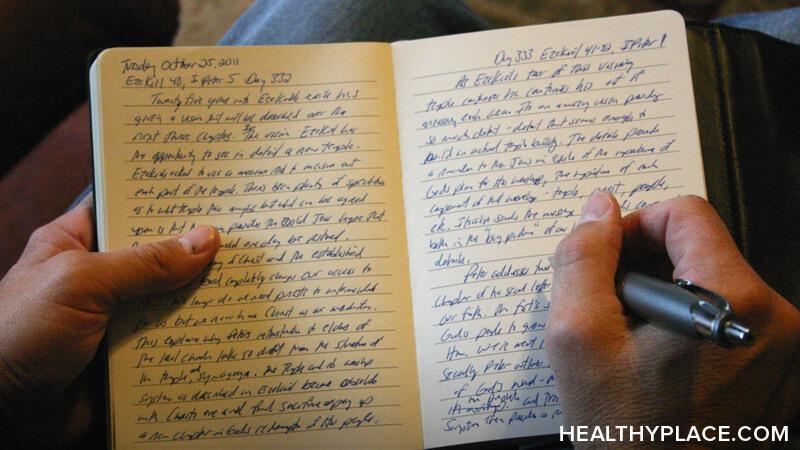
Journaling can be a powerful way to work through the difficult feelings and experiences of self-harm and recovery. When you're at a loss for what to write about, these self-harm prompts can help.
Self-Harm Prompts for Reducing Stress and Overwhelm
These self-harm prompts are ideal for when you feel overwhelmed by something affecting you in the present. They are designed to help you identify what you are feeling, accept what you cannot change, and find ways to change what you can—including your perspective.
What physical sensations am I currently experiencing? (E.g., "My neck feels tense and sore," or "I have butterflies in my stomach.")
What thoughts are currently running through my head? (Try free writing—scribbling down whatever comes to mind for a set amount of time, without worrying about whether it makes sense.)
What names can I give to the emotions I am currently feeling? (Consider whether you are feeling multiple things at once.)
What are some things I enjoy that I can do to feel less overwhelmed? (Try to think of as many options as possible, then circle two or three that seem most appealing.)
If I were to talk to someone about how I'm feeling without worrying about their reaction, what would I say?
If someone I loved were to tell me they were feeling the way I am now, what would I tell them?
Self-Harm Prompts for Recovery Motivation
These self-harm prompts are focused more on the self-harm recovery process—finding inspiration for healing and maintaining motivation over the long term.
Why do I want to be self-harm-free? (Go into as much detail as possible; feel free to list more than one reason if you can.)
How will being self-harm-free change my life for the better?
What is one small thing I can start (or continue) doing today that will help me avoid hurting myself?
What milestones can I set to help mark my progress? How can I reward myself for reaching those milestones? (E.g., "When I reach 30 days clean, I will treat myself to a fancy new journal.")
What does my support network look like? Are there any other groups or individuals I can reach out to in order to strengthen my support network?
What coping strategies do I find the most helpful for dealing with cravings? Which ones might I need to change out for something more effective?
What small, easy self-care practices can I incorporate (or continue to practice) that will help me maintain my mental and physical health?
What events, thoughts, or feelings may have played a part in triggering my relapse?
Are these potential triggers things I can avoid or change in the future? If not, can I change how I perceive or react to these triggers?
How did I feel when I first relapsed? How do I feel about it now?
If someone I love was going through this, what would I say to them?
Do I have a relapse plan in place that I can follow? (If not, now may be a good time to write down some steps you can follow now and, if necessary, in the future as well.)
Rewrite your relapse incident, imagining what alternatives to self-harm you could use to cope with your triggers.
Write a letter to yourself expressing forgiveness, kindness, and understanding.
I hope you find these prompts helpful. If you have other self-harm journal prompts you'd like to suggest, please add them in the comments—the more, the merrier.
Here we are in the second holiday season of the pandemic. Even though things have changed over the past year, there are still many areas of uncertainty and things that are anxiety-provoking. Dealing with anxiety during the holidays becomes vital, and particularly during these uncertain times.
For myself, anxiety tends to increase during the holidays for several reasons. Over the past couple of years, my family has dealt with many changes, and with those changes, I have become very aware of times that I've felt very anxious. So, this holiday season, I have found myself being more vigilant of my anxiety symptoms. I am more aware of what I am feeling and how things are affecting me. One of the things I have found to be so important is to have a strong support system.
Why Social Support Helps Anxiety During the Holidays
Many times, I think the term "social support" tends to bring about ideas that this pertains to being social and being around others in social settings. But even though social support can include that, it is so much more than that. Social support refers to those in your support system, those around you whom you can lean on when you need assistance, and those who can help you cope with stress.
This has become so important during these times, and it becomes critical around the holidays, as there tend to be unique stressors that contribute to feelings of being overwhelmed. I often feel anxious around the holidays, and sometimes it is difficult to pinpoint what has triggered those feelings. But because of this, I also know it is important to lean on my support system, even if it is simply to express what I feel so that I don't feel so overwhelmed.
Talking to someone you trust is helpful to express your feelings, to identify your feelings, and sometimes for helping you to put those feelings into perspective. Additionally, this can be helpful for problem-solving when you are dealing with challenges. Your support system should be a person or persons you can trust who will listen to you and allow you to express yourself without judgment and with care and compassion.
But even more so, during the holidays, leaning on your support system allows you to sustain and maintain positive connections with others, which can help relieve stress. Maybe people in y our life help distract you from things that have triggered your anxiety, or maybe they help you to stay grounded. Maybe they help you to focus on the moment instead of the past or future. Or maybe they simply bring about positive feelings that help to calm your anxiety. In any case, maintaining connections with others is beneficial, especially during the holidays.
During this pandemic, and even if the holidays do not look exactly like they used to, there are still ways to stay connected with others. This includes: taking advantage of technology, making it a priority to spend time with loved ones, and finding ways to interact with others.
As someone who is quite introverted and can find it challenging to engage with others, I have found that being aware of the benefit of maintaining social connections is critical for me in making sure that I do so. Therefore, it is important that I am self-aware of my anxiety -- especially during this time of year -- and that I reach out for help when I know I am feeling particularly anxious. Sometimes, simply being around others is helpful enough to pull me from my worries.
Share in the comments below any strategies you find are helpful for using the support of others to help with your anxiety during the holiday season.
People feel the need to "correct" mental health language constantly. This is mainly a product of political correctness and virtue signaling -- both of which I detest. In fact, talking about mental health and mental illness is like talking through a minefield. Wrong mental illness name -- boom -- you've exploded. Wrong sentence structure -- boom -- you've exploded again. And the thing is, running around correcting mental health language simply shuts down conversation altogether, and that's exactly the opposite of what mental illness needs. Mental illness needs more open acknowledgment, not people shuddering in the dark scared of being publically shamed for incorrectly using words.
Correcting Mental Health Language Examples
Here are some of the ones I detest the most:
I'm bipolar -- wrong -- you have bipolar disorder.
The mentally ill have higher rates of addiction -- wrong -- people with mental illness have higher rates of substance use disorders (that's a twofer).
I suffer from bipolar disorder -- wrong -- you experience bipolar disorder.
All of those corrections just make me want to gag. On the left, you have perfectly acceptable English, no hate language, nothing untoward, and yet, the mental health language on the right is considered to be "correct." And if you dare use any of the examples on the left, people will absolutely jump down your throat and correct your mental health language. No one likes to be corrected, of course, but to be corrected, not because you were incorrect, but because someone thinks they are more correct, is maddening.
Why Do People Correct Mental Health Language?
As I said early, the main reasons are political correctness and virtue signaling. We, as a society, evolve our language over time. This is normal. But the problem is the way we evolve our language. Some evolutions are justified, such as when hate speech becomes no longer tolerable. For example, using a recognized slur in common speech should be corrected. It's just not okay.
However, society has also decided to tune language at the behest of an extremely loud minority -- many of them advocates with decent motivations in their heart. For example, if I say, "I'm bipolar," it's most likely someone who considered themselves an advocate who will "correct" me. These people, seemingly wanting to help people with mental illness, are stomping on me, a person with a mental illness. Nice work.
These advocates, knowingly or not, are often driven by virtue signaling. In other words, they make this "correction" of mental health language specifically to prove that they are more enlightened, a better advocate, or, in short, more virtuous than you. I don't respect this in the slightest. Put your resume up against mine. I have 18 years of experience writing about mental health and mental illness and have written more than 1000 articles on bipolar disorder alone, not to mention that I have lived with bipolar disorder for 23 years now. How are my bona fides? And you're correcting me?
Respect -- Don't Correct -- Mental Health Language Differences
People may be using mental health language you don't agree with for many reasons, and I would ask that you respect that and not jump down their throat. But, at the very least, you can respect people who are using the language to refer to themselves. This video explains more of what I mean:
Because really, here, what we're talking about is mental health language differences. Many examples of mental health language "corrections" are not inherently better; they are just different. If those differences matter to you, then I suggest you go with them. But it's not appropriate to jump down every else's throat just because they either don't know about or don't want to jump on the latest politically correct bandwagon with you. Sure, if someone makes an actual error with regards to mental health, something factually wrong, then, yes, offering more information on that topic is warranted. But stop being the language police. All you're doing is just scaring people away from us and our cause.
Thanksgiving gatherings trigger feelings and emotions for everyone, but not all of those feelings are of peace or gratitude. Some people have wonderful memories of celebrating with childhood friends and relatives. Many of these people feel excited to reunite with loved ones they have not seen in a long time. Other people have unpleasant memories of the holiday. Many of these people feel stressed out, sad, lonely, angry, etc. If you feel anxious or depressed around Thanksgiving, it can be hard to find peace and gratitude. Here are six tips to help you feel better during Thanksgiving.
6 Ways to Find Peace and Gratitude This Thanksgiving
Acknowledge your triggers. If Thanksgiving sparks negative thoughts and feelings for you, it is important to identify your triggers. For instance, if you have lost a loved one around this time of the year, you might feel depressed. If you know that you will see a toxic family member, you might feel anxious. As hard as it is to let yourself think about your triggers and emotions, doing so will allow you to mentally prepare for gatherings.
Talk to trusted family members or friends. Struggling with anxiety and depression can feel very lonely. You might think no one wants to hear about your concerns. But the truth is, someone in your circle might feel the same way you do. By picking out a few people to talk to about grief or a toxic family member, you can come up with ways to get through the festivities together. If you are close to the host, you can ask for permission to invite a friend to the celebration.
Give yourself time to relax. People often make a big deal about the time around this holiday being busy. But it does not have to be busy for you. It is okay to enjoy some time with yourself, especially before a big celebration. Ask a loved one to babysit your child while you take a nap. Bask in a bubble bath. Turn off your phone. Decline a party invitation. Do what makes you feel relaxed so that you will be ready for the holiday activities.
Create a mental health wellness plan with your therapist. Having a mental health wellness plan is essential to cope with mood disorders at any time of the year. This is especially true around Thanksgiving. Your therapist can help you identify your triggers, come up with coping activities, and create a list of supporters to contact. By having coping strategies and support contacts in place, you will feel more confident and relaxed before a gathering.
Set appropriate boundaries. If someone says something that triggers you during your feast, it is okay to set boundaries. Tell the person that you do not feel comfortable talking about a certain topic. If they do not listen, politely excuse yourself from the table. Taking action to maintain your boundaries will help you gain control of your emotions.
Create a simple gratitude list. At this time of the year, many people share several things that they feel grateful for. Facing negative events and emotions around Thanksgiving can make it difficult for you to find gratitude. If this is the case, come up with two or three things that make you feel good. For instance, do you have specific friends or family members who lift you up? Do you have a favorite memory, hobby, or food? As trivial as these things might seem to others, they are important to you. That is what matters.
Try at least one of these strategies this Thanksgiving. Do you have any of your own coping techniques? If so, help others find peace and gratitude by sharing your ideas in the comments.
I have been taking antidepressants since 2018, even though they make me lazy. They are lifesavers that help keep my clinical depression down to a manageable level. However, they come with a hard-to-ignore drawback: they make me feel drowsy. I have long been one of those people who are slightly sleepy at all times. Antidepressants, while giving me clarity of thought and a will to live, make me more sluggish than usual.
Antidepressants Make Me Lazy: Significantly Less Productive
All medicines have a range of side effects, and antidepressants are no different. Side effects vary from person to person, and so does the intensity. While I have to put up with a few other undesirable side effects due to my medication, they are low in impact. Drowsiness is by far the worst side effect that affects both my personal and professional life.
It's a given that if you are feeling constantly sleepy, you will be less productive. In other words, my antidepressants make me lazy, or at least less awake than I used to be when I was unmedicated. Today, I have to consistently push myself to do things that "normal" people accomplish without a second thought. From waking up when my alarm rings to beginning work in the morning, many things are a struggle for me now. Even though I try my best to be productive, there are days when I get tired of fighting the urge to rest. I often give in and take some time off. I rearrange my schedule according to my energy levels to make time for a nap or two.
The Pros Outweigh the Cons
In a fairer world, antidepressants would not make me want to lie in bed as much as possible. However, feeling drowsy is a small price to pay as compared to the pros of antidepressants. I would rather be groggy and less productive on medication. Because I know that the alternative will lead to unmanageable levels of depression and increased suicidal ideation, I will continue to take my pills. Ultimately, my life is much more valuable than the number of hours I put in at work. Depression is a disability, not a choice, and I will not apologize for taking care of myself. Yes, my work matters to me, but my quality of life is far more important. I will continue to take my antidepressants for as long as I need them.
Are you medicated? What effects do your pills have on your productivity and work-life in general? Please let me know your experiences in the comments below.
If you are leaving an abusive situation or are trying to put one behind you, congratulations. Finding the strength to do what is best for you can be difficult, but it is worthwhile. However, recovering from abuse, whether verbal, emotional, physical, or otherwise, is not easy, and the path can be full of triggers or roadblocks.
Why Proper Abuse Recovery Is Critical
You may think that everything will be okay once you leave a verbally abusive situation, and your life will return to normal. Unfortunately, for many individuals, that is not the case. The effects of verbal abuse can last for years, especially if the victim does not seek active recovery treatment and healing methods.
Without proper healing and recovery, individuals may harbor resentment, mistrust and have silent triggers that can cause their emotional state to spiral without any warning. This hampered emotional state can directly affect the victim's personal relationships, work environment, and any interactions with others throughout life.
Sometimes the individual does not even realize why negative circumstances happen to them because they cannot see how their deep-rooted internal scars are altering their world. Not surprisingly, childhood abuse, trauma, and neglect can physically change the brain's composition, significantly impacting a child's developmental milestones.
Proper recovery from abuse can help reduce the ill effects of abuse, whether it comes from childhood, an intimate relationship, or a workplace environment.
Some Considerations with Abuse Recovery
If you want to recover and heal from abuse, I applaud you. Taking steps to find a healthier balance in your life is challenging and is not always easy. It is important to take in some of these considerations when you are on the path of healing from abuse.
Your recovery will look different from someone else's. Do not compare your healing to others since each individual will move away from abuse differently.
Be gentle and patient with yourself. You may be fine one day and face harsh triggers another day. This process takes time and will not happen overnight. Remember that you are doing the best you can right now.
Try to eat healthy, exercise, and get enough rest. Taking the necessary steps to feed your body and mind will be especially important during your healing.
Do not avoid asking for professional help. Healing from abuse is a messy situation, and having someone with training to provide the tools you need can make a huge difference.
Accept any negative thoughts you may have, process them, and then move past them. Do not ignore your sad or angry feelings since this will just prolong your recovery. Accept them and learn how to move on from them so you no longer dwell on these negative emotions.
There are many ways that you can recover from abuse. Finding which methods and tools work best for your situation can help you heal and move forward away from that part of your life. Remember that you are never alone in your journey, and take your recovery one step at a time.
Maintaining a self-harm sober streak can be difficult in the best of times, but for many people, the holidays can be especially trying. Here are some things to keep in mind while walking the path of self-injury recovery this holiday season.
Why Staying Self-Harm Sober During the Holidays Is Hard
It doesn't matter whether your self-harm sober streak has lasted a day, a month, or a year. The holidays represent many things to many people, but all too often, they hang upon us a pressure that can be overwhelming to bear—especially if you are trying to bear it alone.
If you see the holidays as a stressful time, the source of that pressure is obvious. But even if you look forward to the so-called "season of giving," there's stress inherent in that, too. You may feel pressure to buy beyond your budget, or to spend time with people you would rather not. Even if you're excited to celebrate with friends and family, that's still positive stress.
And all of that excitement and stress builds and builds, and can quickly become too much to carry if you do not have the support and coping strategies in place to deal with it healthily. And if you turn to self-harm to cope, the stress of relapsing—and of hiding that relapse from friends and family—may only make matters worse.
How to Maintain a Self-Harm Sober Streak in Times of Stress
If your perception of the holidays is a positive one, it's easy to get wrapped up in preparations and festivities and forget to look after your mental health. And if your outlook is negative, the difficult feelings that this season can stir up can also trigger self-harm cravings.
In both cases, the most important thing is to make space for self-care. If your schedule is full to bursting, try and cancel a few activities where you're able and pen in some time just for you. If your schedule is empty, avoid isolating yourself completely. Try and make some plans, whether in person or remotely, with people you enjoy spending time with. You don't have to celebrate anything you don't want to; it's enough just to have a good time together.
If you feel you don't have anyone you can turn to for help, support, or good cheer, now is a great time to look into joining a support group. Don't feel up to it? Try a hobby group instead—anything that you could conceivably enjoy doing with other people, whether online or locally.
Now is also a good time to consider therapy. If you're not already actively attending sessions, signing up now for some kind of professional mental health support can help boost your ability to stay self-harm sober during the holidays. If you can't attend in person, remember that there are remote options, too.
What If You Break Your Self-Harm Sober Streak During the Holidays?
First of all, don't panic. You're far from the first person—or the last—to relapse during the holidays. There is help available if you need it. Call emergency services or a hotline if you need urgent help, or call your therapist. If you don't have one, talk to a friend or family member if you can. You can even comment on this blog if you like.
The important thing is to reach out to your support system. If you don't have one, there's no time like the present to begin building one.
Remember, relapse during the holidays isn't uncommon. It's an overwhelming time for many of us, myself included. While yes, it's obviously better to avoid relapsing if you can, know that if you cannot, it does not mean you are a failure or that you are weak. It simply means that you have stumbled along the path to recovery, but you can still pick yourself up and begin again.
Just take it one day, and one step, at a time. And remember what the holidays are really supposed to be about—love. That includes self-love; never forget that.
It's no secret that depression can affect your behavior -- that it can cause you to do and say things you wouldn't ever otherwise do or say. But when should you hold yourself accountable for bad behavior? And to what extent does mental illness excuse bad behavior? What kind of allowances should we expect in times of poor mental health, and what kind of allowances should we be prepared to grant to others? When is depression simply not an excuse?
Does Mental Illness Excuse Bad Behavior? When Should You Hold Yourself Accountable?
When do you hold yourself accountable, or hold a friend accountable, for bad behavior due to mental illness? A friend recently shared that someone in her life was treating her poorly: she was being rude, demanding, and manipulative. "But, you know, she's going through a lot, and her mental health hasn't been great," she said.
This struck me as a very charitable way of looking at what was essentially bullying on the part of this other person. And it got me wondering whether anyone had ever made that same excuse for me when I was experiencing a mental health crisis.
I know for a fact that I have been rude, unsympathetic, and unreliable in times of poor mental health. And yet, the people I subjected to this version of me are still part of my life to this day. Why? Because they didn't let me get away with it. They called me out on it -- with love.
Behavior Can Be 'Excusable But Not Acceptable'
I like to think of the kind of "bad" behavior we exhibit when we are struggling with our mental health as excusable but not acceptable. There might be a reason for it, but that does not mean other people should have to tolerate it.
Everybody is entitled to be treated with respect, and no mental health diagnosis makes you exempt from that fact. Being held accountable for my behavior when I was ill helped to counteract the feelings of dissociation I had started to develop. Being forced to confront the way my actions were affecting those closest to me helped me to feel that I was still an important part of their lives.
Sure, they made exceptions for minor slights and insignificant offenses, but they refused to infantilize me, and for the most part, I got called out on my bad behavior -- because while it might have been excusable, it was not acceptable.
Holding Yourself Accountable Is a Vital Step Towards Recovery
We have all done and said things we regret in times of poor mental health. But holding yourself accountable in the moment helps you to remain present in your relationships by reminding you that your illness does not trump another person's right to respect.
Equally, it is important to remember that coddling a person with a mental illness when they have offended you or violated your boundaries is not helpful to them -- all it does is give them a reason to sink further into the void, into the place where their actions and their words have no value or meaning. By holding them to account, you remind them that they still have a place in their family, their friendship group, their community, and most importantly, in your heart.
So while it might be painful, uncomfortable, and difficult, it's time we started calling each other out. No excuses.
In a recent post, I discussed why I like wearing comfortable clothes to manage anxiety and what, specifically, comfort means to me in that context. In this post, I want to do something similar, only this time I’m discussing furniture as opposed to clothing. Again, ensuring one’s furniture is comfortable is a pretty self-evident thing to do, but like my recent post, I want to go into a bit more detail with regards to what that means to me.
I’ll Spend More on Comfortable Furniture to Ease My Anxiety
I’m the kind of person that doesn’t like to splurge on a lot of stuff. I find that I don’t really find that much of a difference in buying something expensive as opposed to the cheaper alternative, so my philosophy tends to be to not spend a lot because the end result doesn’t matter.
I do make a few exceptions to this rule, and one of them is for furniture. I’ve never been afraid to spend a bit more money on, say, a comfier memory foam mattress, or a softer couch. When I’m at home, I spend a lot of time on the couch, watching movies or playing video games, or sometimes taking naps. If I’m going to be spending that much time somewhere, I want to make sure I’m as comfortable as possible.
How I Feel Comfortable on My Furniture
I’m the kind of person that doesn’t often feel secure. That’s what my anxiety tends to do. Even when I am secure, I won’t feel secure. Because of that, trying to feel secure is a big deal for me.
That’s where my comfy furniture comes in. When I’m lying on my extra-long, soft couch, or my memory foam mattress, I feel secure. It almost feels like I’m being hugged. This goes double if I’m wrapped in a comfortable blanket, and so it comes as no surprise that I have blankets everywhere and I always use them, even in the warmer parts of the year.
If I didn’t have these things, I don’t know what I would do. I would feel uncomfortable and insecure in my own home, and that would be horrible for my mental health.
That’s the ultimate takeaway here. Surround yourself with things that physically make you feel comfortable and secure to the best of your abilities, because if you’re not living in the kind of environment, what’s even the point?
Why am I, a queer woman of mostly European descent, talking about the movement to decolonize body image? The answer is simple: because it matters—therefore, it must be talked about. In the United States, November is recognized as National Native American Heritage Month,1 which makes this as ideal a time as any to further the conversation.
Born from the tireless efforts of numerous tribal nations to raise awareness for both their contributions and connections to this land, National Native American Heritage Month seeks to honor the ancestry, traditions, resilience, and cultures of Indigenous people, who have faced generational trauma, injustice, and erasure for centuries.
This has me reflecting on how the bodies of Black, Indigenous, and People of Color (BIPOC) are too often viewed as "less than" due to Western colonial beauty norms—and why it's so crucial to amplify the movement to decolonize body image across all ethnicities. As cliché as this might sound, I believe knowledge is the first step to collective empowerment and, ultimately, action. So I think it's worth examining how the effects of colonization can cause harmful body image distortions or eating disorder behaviors within marginalized communities.
The Link Between Colonization and Harmful Body Image Beliefs
According to research from Marisol Perez, Ph.D., an associate professor at Arizona State University and Fellow in the Academy for Eating Disorders, more than two million U.S. women of Black, Latinx, Asian, or Indigenous descent will suffer from an eating disorder in their lifetime.2 But even as of 2020, those who identify as BIPOC are still half as likely to receive a diagnosis and access to treatment as their White counterparts.3 It's a cruel irony that marginalized communities forcibly bear so much internal shame and trauma around their external appearances, while historically not being offered resources to heal.
But there's no need to take just my word for it. Gloria Lucas is the founder of Nalgona Positivity Pride, a Los Angeles-based organization that strives to make eating disorder recovery more equitable, accessible, and culturally sensitive for ethnic or racial minorities. Here is what she says about the link between colonization and toxic body image beliefs or assumptions:
"People of color receive mixed messages about their bodies. There’s the message that we’re inferior, that we are dirty, that we are ugly, that we’re not intelligent . . . Part of the reason we don't love ourselves is that we don't get celebrated [or] recognized."4
As Lucas also points out, when these belief systems are passed from one generation to the next, it's hard for BIPOC communities not to internalize the myth that "white, slender bodies are desirable, [while] darker, curvier bodies are not."
This conditioning can result in low self-esteem, as well as an increased risk of eating disorders or other mental health issues. In fact, even many of the mainstream initiatives to normalize body acceptance often do not center a diverse enough representation of all skin colors. That's why Lucas, who identifies as Xicana-Indigenous, is on a mission to decolonize how this culture thinks about body image as a whole.
Decolonize Body Image Beliefs to Promote True Body Acceptance
I'm no expert on which steps modern society can take to overcome centuries of Western colonial ideologies that continue to influence the treatment—or lack thereof—of BIPOC bodies. But I feel it in my bones: this movement to decolonize body image matters, and I want to amplify the voices of people who do this work however I possibly can.
National Native American Heritage Month is not the only time to shine a light on those who have seen their experiences in this country erased from the mainstream narrative and their outward appearances given the label of "inferior," as Lucas puts it. This must be a year-round conversation in which body acceptance becomes the norm for everyone—across all races, ethnicities, physical builds, skin colors, and cultural backgrounds. In my own humble opinion at least, that's why this movement to decolonize body image matters.
What are your thoughts on this topic? I realize it can be quite a nuanced, complex discussion—and this article only begins to scratch the surface—so I welcome your feedback, experiences, and insights. Please share in the comment section below.