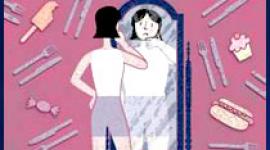
Recovery from Overeating with Joanna Poppink, MFT


Joanna Poppink, MFT, our guest, maintains that the biggest blocks to recovery from compulsive overeating are misinformation about the eating disorder, and an over concern about what others think as opposed to a focus on how the eating disordered person thinks, feels and experiences the world.
David Roberts is the HealthyPlace.com moderator.
The people in blue are audience members.
David: Good Evening. I'm David Roberts, the moderator for tonight's conference. I want to welcome everyone to HealthyPlace.com.
Our topic tonight is "Recovery From Overeating". Our guest is therapist, Joanna Poppink, MFT. Joanna's site, Triumphant Journey, is located inside the HealthyPlace.com Eating Disorders Community. At her site, you can also find her "Cyberguide to Stop Overeating and Recover From Eating Disorders". Joanna has been in private practice since 1980 in Los Angeles, California.
Good evening, Joanna, and welcome to HealthyPlace.com. We appreciate you being our guest tonight. I think the people in our audience are very interested in recovery from compulsive overeating. You said one of the biggest blocks to accomplishing that is misinformation. What kind of misinformation are you referring to?
Joanna: Hello David and everyone. I'm delighted to be here.
People usually think of eating disorders as having to do with food and eating or non-eating behaviors. If that's the limited perception, then the cure is simple. Just stop doing it.
But I'm sure everyone in this discussion appreciates that recovery is not so simple. Guilt, shame, fear, distorted perceptions, are all symptoms of the disorder as well. The internal life of the person with the eating disorder, needs to be respected and understood with compassion and intelligence. Recovery covers a lot more territory than eating or non-eating behavior.
David: By the way, if anyone in the audience isn't sure if they are a compulsive overeater, Joanna has a questionnaire on her site that may help you.
You also mentioned another big block to recovery from compulsive overeating is an overconcern about what others think vs. how the overeater thinks, feels and experiences the world. Can you explain that?
Joanna: Briefly, I'll try. An aspect of the symptoms of an eating disorder is the desire to be perfect. Perfection is defined by the individual and usually has to do with goals that cannot be achieved, like looking beautiful all the time, having a flat stomach, a four-point grade average, a winning job situation, a "perfect" partner, and so many other attributes.
Often the person struggles to maintain an image of perfection, even to the point of lying and using other forms of subterfuge to convey the perfect image.
Also, people in the eating disordered person's life may come to expect an impossibly high standard to be maintained. Then we've got a painful situation where people are trying to live up to what they believe are standards in other people's minds as well as their own.
Nobody knows anybody, really. The false presentation is a terrible burden to carry. It's a set up for disappointment and painful disillusionment.
David: What causes someone to become a compulsive overeater? (overeating causes)
Joanna: That's the 64,000 dollar question. I can give you a list of possibilities. These possibilities are indeed factors in people becoming compulsive overeaters. BUT, there are many people who experience these stressors and do not become compulsive overeaters.
In my opinion, from my experience, from hearing the stories of many hundreds, perhaps thousands now, of people with eating disorders I have never once heard anyone say they wanted to have an eating disorder. No one chooses it. No one wants to die. No one wants to be fat. No one wants to be skeletal. No one wants a life of lies and deception and isolation.
The person with the eating disorder developed the eating disorder to help them cope with what they could not cope with any other way. This usually has to do with some kind of stress that creates unbearable anxiety. Unbearable anxiety means just that. The person cannot bear to experience their feelings, so the compulsive overeating comes in to numb them out. Unbearable stress comes in many forms: usually it has something to do with the person's humanity being disregarded in some way. This could be emotional, physical, spiritual.
I have an article I call the Number One reason for developing an eating disorder. It's about disregarding boundaries, i.e. disregarding where one person begins and another ends. However, please remember, not all people in such situations develop eating disorders. Such coping mechanisms as alcoholism, drug use, compulsive exercising, compulsive work, addiction to drama, control, sex, etc. are all ways of coping with the unbearable. And sometimes they overlap with each other.
David: Joanna's "Cyberguide to Stop Overeating and Recover From Eating Disorders" can be found on her site at HealthyPlace.com. You'll definitely want to take the time to read it because it helps you understand why you may be overeating and then, there are exercises to help you stop.
Here's an audience question, Joanna:
|
|
Mandy79: I'm not fat or anything, but I do admit that I am an overeater, and this is the cause that led me to be bulimic. I wanted to be in control of my body. My boyfriend is trying to help me with my eating disorder, but I don't know where to start. I feel so alone and reserved. How can he help me?
Joanna: Hello, Mandy. Thank you for speaking up. You are helping yourself and others with your question.
First things first. Before your boyfriend can help you, you might start thinking about the best way for you to help you. Then, he can follow your lead.
Sometimes friends and family think they can help by not eating sweets in front of someone. Or they can suggest that a person eat or not eat. This is getting into the behavior and not the dynamics of the person.
Actually, the best way, I think, to help a person with an eating disorder, is to treat them normally with the expectations they would have of any healthy person. That can help the person with the eating disorder see where their behavior and feelings are part of their illness. It can help a person be more aware of their own situation and show them where they need to get help for themselves. If you get on your own healing path, you'll know how to have him help you.
Good luck to you both, Mandy. He sounds like a nice guy. And you sound great yourself.
dr2b: How do you know when you are actually "overeating"?
Joanna: Actually, your stomach is about the size of your fist. Not very large, is it? Of course, it stretches. We can feel our stomach stretching when we eat. People unbuckle their belts and loosen a button or two at Thanksgiving.
When you eat because you are hungry, you could stop when you are no longer hungry. The problem is that we, in this affluent country, often do not eat because our bodies are hungry for nourishment. We eat for entertainment, for soothing, for social reasons, for family reasons. So we need to learn how to recognize our body sensations. Then we can know when it's time to stop eating.
A big problem for compulsive overeaters is that eating is the process used to create numbness. When you are numb, you are not sensitive to your feelings and so you can go on eating long past the time your body wants and needs you to stop.
I recommend yoga classes for my patients because a sensitive yoga teacher can help a person become more in touch with the sensations of their own body, and learn to respect their body, and learn to recognize body signals. Then, you can begin to treat your body more kindly, including that little stomach that really does not want so much food in it.
David: Here's a question related to what you were just talking about, Joanna:
Jill: I realize that I rely on food when I'm depressed. I eat when I'm not hungry. Is there anything I can do to stop this habit?
Joanna: Hi, Jill. You are raising the inner dynamic issues that are crucial in understanding and healing from eating disorders. Learning how to sit with yourself while you are feeling depressed, or feeling anything else that is difficult to bear, is the key to recovery.
So, how can you sit with yourself? First, how can you be with yourself while you are feeling depressed without doing something to numb yourself? I suggest that you make a list, when you are not very depressed, of all the things you enjoy. Give yourself a different kind of menu. Give yourself an assortment of activity selections that are kind to you, soothing and comforting to you and special to you.
- You might like walking in a garden.
- You might like taking a bath.
- You might like painting a picture or writing in your journal.
- You might like petting your cat or dog.
- You might like visiting an antique shop, a museum or art gallery.
- You might like listening to Sting or Mozart.
Make a list of what's delightful and loving for you. Post it somewhere that is obvious. When depression comes on, look at your list. Then, use your strength to pick one and try it. You can tell yourself that you are postponing eating. After all, you can always eat, so you'll eat later. First, you'll nourish yourself in one of these other ways. Sometimes people postpone a binge for the rest of their lives. This is how it starts.
David: Joanna, are there emotional or physical cues that trigger the compulsive overeater to eat? For example, smokers often have a cigarette when they have a cup of coffee.
Joanna: Well, there are probably cues for everyone, or most everyone. Movies and popcorn leaps to mind. Halloween and particular candies. Most holidays probably have a food association that, for an eating disordered person, can trigger a binge.
But most likely, a situation that feels like an old situation that was painful, stressful, frightening, despairing, could trigger a binge. The situation doesn't have to be terrible itself. It just has to remind the person of a terrible experience. They often don't even know consciously that it's happening. Family visits, especially to the home of childhood, often trigger binges. There is so much there to remind the person of childhood hurts. And, often the original binge food is still in the fridge and the cupboard.
Sometimes a look or expression from someone brings up feelings that are unbearable. And that's the key. When something starts to come up that is unbearable, the binge eating begins.
|
|
Blue: How can I feel my feelings, when I don't even know what feelings I'm hiding from? When I binge, I don't necessarily know why I'm doing it. I mean, it's easy to understand if you have a fight with your spouse, or a bad day at work, or any other obvious reason.
Joanna: You can't know in advance, and you don't have to know.
Your feelings and your associations are being remembered and expressed through your body. So first we get in touch with the body and bear what the experience is. Often we (and I say we, because this is a human experience not exclusive to people with eating disorders) feel something, and then use our clever minds to try to come up with a reason, a local external reason for our experience. It makes us feel in control. It also makes us feel hopeful. If we know that it's 'his" or 'her' or 'it's' fault, we can do something to make the problem stop. Often this kind of thinking doesn't work and just creates more problems.
So again and again, the healing effort goes into postponing, waiting, being still, staying with whatever we feel until eventually it passes or we get a helpful association to bring to our therapist to work on.
dr2b: Do you feel that there are truly "trigger" foods, and that you (like an alcoholic) must totally abstain from them?
Joanna: Healing from eating disorders proceeds in stages. Not systematic, planned, controlled stages. Not stages where anyone could criticize themselves for skipping stages or going out of order, but stages nonetheless. Someone in early eating disorder recovery is often quite terrified. She or he can feel that the eating disorder is just waiting to jump out at any time and take over. So certain foods that have been classic binge foods are emotionally loaded.
Also, going back to a previous question, the physicality of the binge food, the way it feels in the mouth going down, the taste, the consistency, are all familiar physical sensations that can invite a person back into old habits. So early on it's probably a very good idea to avoid binge foods. But, at some later time, we want to revisit those foods. Not because you have to eat them. You could probably live your life without ever eating those particular foods again. But, wouldn't it be nice to get the fear out of the association, so you eat or don't eat something out of choice and not out of fear?
So when you are ready to experiment, to tiptoe back to those old scary places, like a child grown older who is looking in what used to be a scary closet, you do. You take the fear out.
Healing is freeing. It's very nice to discover that you can live as a free person. It's nice to know that you can choose based on your own deep authentic feelings and desires.
debpop: Sometimes I eat and the food tastes so good. I could be stressed or not, but I end up eating more than I need to. I know when I am full but I feel I can't stop. How can I stop?
Joanna: You are saying that you are experiencing a rich experience of pleasure while eating. I wonder where else you experience pleasure? The good feeling from eating is comforting, good company, fun, entertaining. Where else in your life can you have those experiences?
If your choices are limited, it's only natural that you would want to get as much as you can from what you do have available, i.e. delicious food.
I invite you to think about putting more pleasure in your life that takes other forms. Then we would find out if you would choose food over these other ways of enriching your experience
David: I'm assuming that recovery takes a lot of hard work. What are the benefits someone will derive being able to stop overeating?
Joanna: A new and amazing world opens up and you can run and play and work and love in it. When you stop overeating you start feeling what you could not feel. At first you feel some pretty difficult emotions. But... once you are able to feel those, you also start to feel other kinds of feelings, wonderful feelings that were buried and numbed along with the pain.
These feelings, all of them, help you choose people, places, things, ideas, activities, that are directly related to what you genuinely care about, now that you are capable of genuinely caring. Can you imagine the difference this means to someone's life?
- What if the people in your life were people you really wanted to be with?
- What if you were eager to go to work?
- What if you were eager to be at home?
- What if you experienced joy at being with yourself?
And, of course, there are health benefits. You'll live longer and healthier. In my personal opinion, there is no beauty treatment that compares to health and joy. And that comes with healing.
David: So many times Joanna, well-meaning people will say to the overeater: "all you have to do is not eat all the time." But we know it's not that simple. What makes it so difficult to stop overeating?
Joanna: When we are babies we are pretty helpless. We have two abilities that are essential to survive. We can cry, and let our caretakers know we are in distress. We can suck, to take in nourishment. So eating, taking in nourishment, hooks into the very basic feelings of survival.
There is a powerful biological imperative to continue the individual life and the species that goes far beyond any emotional or intellectual decision of our adult lives. When we eat to numb ourselves we are eating to protect ourselves from feelings we cannot bear. That means that we believe in an unconscious and primitive way that we will die if we feel those feelings. So we are back in that early stage where we are taking in nourishment so we will stay alive.
This is extremely powerful. It's why recovery takes time. It's why trust and developing trust in stages, as it is earned, is so crucial in recovery. A person will feel (even though their mind says differently) that they will die if they stop overeating. This is why people in recovery develop courage. It truly does take courage to heal.
David: Thank you Joanna for being our guest tonight and for sharing this information with us. And to those in the audience, thank you for coming and participating. I hope you found it helpful.
Joanna: Good-bye all. It was a pleasure for me to speak with you tonight. Thank you for your wonderful participation.
David: Good night everyone.
Disclaimer: We are not recommending or endorsing any of the suggestions of our guest. In fact, we strongly encourage you to talk over any therapies, remedies or suggestions with your doctor BEFORE you implement them or make any changes in your treatment.
|
|
APA Reference
Tracy, N.
(2007, February 26). Recovery from Overeating with Joanna Poppink, MFT, HealthyPlace. Retrieved
on 2026, August 2 from https://www.healthyplace.com/eating-disorders/transcripts/recovery-from-overeating