In the world of mental illness and mental health there is a strange border territory where victims and criminals mingle, cause and effect chase one another round and round the barn, and responsibility is almost impossible to assign. I am speaking, naturally, of drug and alcohol abuse.
In the eyes of some, drug and alcohol abusers are simply victims of their own hard-wiring, guiltless as the man who, strolling down a city sidewalk one fine spring morning, is crushed to death when the rope being used by non-union piano movers to transport a Baldwin upright into a 4th floor cold water walk-up apartment casts aside its amateurishly tied knots and surrenders to gravity.
In the eyes of others, dipsomaniacs and drug abusers are merely self-destructive whackadoomians intent on beating the reaper to his work. There is little sympathy to be found among the members of this chilly community.
Funny in the Head

While society may be quick to apply the term “mental illness” to a broad spectrum of behaviors, it is slow to acknowledge the idea that sanity itself is an elusive entity, difficult if not impossible to define, and largely reliant on context.
What do we mean by this? Well, let's pick a simple example. If you're a half-eaten jelly doughnut in Akron Ohio, you are also a half-eaten jelly doughnut in Chagrin Falls, Calcutta, Medicine Hat, and St. Petersburg. In other words, location has no impact on how you are perceived, valued, or for that matter, consumed.
The same cannot be said for behavior designated as inappropriate, which is to say, demonstrating some form of mental illness. Behavior considered the height of fashion in Cheboygan, (assuming there is fashion in Cheboygan) might be considered bizarre, disturbing, and unwholesome in Chad, Bongo Bongo, and Ulm.

In a surprise move certain to send shockwaves through both sporting and psychiatric communities, the American Whackadoomious Association (AWA) has declared it no longer recognizes ice fishing as a sport and has officially designated it a form of mental illness.
In a press release carefully timed to coincide with closing ceremonies at the Sochi Winter Olympics, AWA Sports Awareness Director, Quimby Entwhistle, announced, “The AWA could no longer sit idly by and pretend that ice fishing is a sport in any way, shape, or form. You might say it became our elephant in the room, and the room was sitting on a frozen lake riddled with ever-widening cracks.
Branding has never been more popular in mainstream American culture. Roughly speaking, a brand is the idea a prospect has of a given company. When I say NFL, you conjure up a host of opinions and preconceptions. The NFL is one of the most valuable, and fiercely protected, brands ever created.
The NFL is careful to distinguish between authorized, sanctioned goods/services and off-label, bootleg material. Let’s say you're on your way to enjoy a football game at a major market stadium somewhere in the United States. You walk across the expansive parking lot where people burn chicken parts, drink excessively, and gesticulate with misplaced passion in the mistaken impression that their delirious enthusiasm may somehow influence the upcoming game’s outcome.

I hope you'll stop me if you've heard this story before. It might be true, then again it might not be. I am, as you are almost certainly aware, in the habit of making things up.
Like so many people who are creative for a livelihood, there comes a point when I am no longer able to distinguish between what I have made up, what I am claiming to have made up but in fact have not, what I don't know if I’ve made up or not, and what I absolutely know to be true, to the extent it is ever possible to be certain something is true, which it isn't. But enough about my methods.
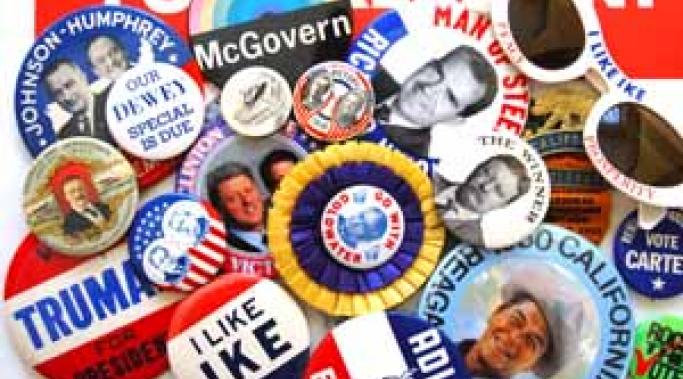
America may not be perfect, it may not even be pluperfect, and, truth be told, its glory days as a superpower seem to be shrinking faster than telephone poles in the rear-view mirror of a Cadillac El Dorado fleeing a crime scene. However, there is one area in which we have progressed nobly, that is, making good on our constitutionally guaranteed claim of unequivocally equal opportunity for all, regardless.
It seems incredible today but, when I was just a little Funny In The Head, JFK’s Catholicism was a source of fierce debate and considered a political liability. When Barack Obama became president he made history because of his racially mixed heritage. Today, many people believe that Hillary Clinton will be our next president, which would make her the first woman to smash through the nation’s loftiest glass ceiling.

Of all the months, January surely lays claim to the title of, “redheaded stepchild". Is there any month with such an image problem? The icicles which only weeks ago seemed to twinkle magically in expectation of fun, food, festivities, frivolity, and convivial camaraderie, now appear like menacing, pointed teeth in the jaws of a hideous beast intent on devouring us with short days, cold nights, bitter wind, and impassable roads.
These are the days when you realize that watching your microwave oven heat a burrito is more edifying than watching TV. You gaze upon the walls of your home expressionless as a doll, unblinking eyes the size of pie plates, looking for anything, anything at all to relieve the ennui and postmodernist dread.

One of the consolations of age is the transformation of one's relationship with time. As a young man, I agonized endlessly about the future, speculating and puzzling over a never-ending succession of questions. Would it arrive on time? Would there be enough of it to go around? Would it be in color? Would it be three-dimensional? Would it have sufficient volume to fill the allotted amount of space?

Well it's that time again; time to wish Funny In The Head readers a Happy New Year. But before we go any further, let us concede quickly that this familiar, comforting phrase means different things to different people, indeed, it would be hard to find two people who defined a happy new year in identical terms. So I'll hasten to qualify by saying that I hope for you a New Year which conforms to your conception of what a New Year resembles, rather than someone else's.
Which brings us, I hope, to the subject of today's column, the advisability of New Year's resolutions among those who, through no fault of their own, reside in Greater Whackadoomia, an ever-increasing population cluster located within whistling distance of the outskirts.
Since that awe inspiring moment when time and human introspection first collided, guilt-ridden people have attempted to ascend the moral ladder by means of the psychological parlor trick known as - a New Year's resolution.

Have you heard this one already?
Three clinically depressed highjumpers walk into a bar. They lower it.
I’m kidding of course.
Then again, I’m not kidding, (as always), because if there is anything that will help today’s mentally ill individual survive the three-ring-circus of psychological torment and emotional Armageddon known by that deceptively sweet euphemism – the holidays – it is lowered expectations.
Why? With every layer of tinsel, every rehashed Christmas chestnut mangled by Beyoncé, every eggnog-infused martini, every promise of no money down and no payments for the first seventeen months, every drug-addled midnight greeter at Walmart scratching his most recent tattoo, every ill-considered fax at every office party, and every other cliché of Christmas cacophony and tintinnabulation comes the rising tide of truly ho-ho-horrible inevitability – the hopes, the joys, the fears of all the years, reindeer and pain dear – that Grinch-ish thief of all that is merry; expectations.