Diabetes Complications: Heart Disease and Stroke

For people with type 2 diabetes, heart disease and stroke are the number 1 causes of death and disability. Here's what you can do about this diabetes complication.
At least 65 percent of people with diabetes die of some form of heart disease or stroke, according to the American Heart Association. By controlling your risk factors, you can avoid or delay cardiovascular disease (heart and blood vessel disease).
Contents:
- What is the connection between diabetes, heart disease, and stroke?
- What are the risk factors for heart disease and stroke in people with diabetes?
- What is metabolic syndrome and how is it linked to heart disease?
- What can I do to prevent or delay heart disease and stroke?
- How will I know whether my diabetes treatment is working?
- What types of heart and blood vessel disease occur in people with diabetes?
- How will I know whether I have heart disease?
- What are the treatment options for heart disease?
- How will I know whether I have had a stroke?
- What are the treatment options for stroke?
- Points to Remember
Having diabetes or prediabetes puts you at increased risk for heart disease and stroke. You can lower your risk by keeping your blood glucose (also called blood sugar), blood pressure, and blood cholesterol close to the recommended target numbers—the levels suggested by diabetes experts for good health. (For more information about target numbers for people with diabetes, see "Diabetes Complications: Heart Disease and Stroke"). Reaching your targets also can help prevent narrowing or blockage of the blood vessels in your legs, a condition called peripheral arterial disease. You can reach your targets by
- choosing foods wisely
- being physically active
- taking medications if needed
If you have already had a heart attack or a stroke, taking care of yourself can help prevent future health problems.
Connection Between Diabetes, Heart Disease, and Stroke
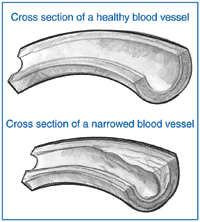
If you have diabetes, you are at least twice as likely as someone who does not have diabetes to have heart disease or a stroke. People with diabetes also tend to develop heart disease or have strokes at an earlier age than other people. If you are middle-aged and have type 2 diabetes, some studies suggest that your chance of having a heart attack is as high as someone without diabetes who has already had one heart attack. Women who have not gone through menopause usually have less risk of heart disease than men of the same age. But women of all ages with diabetes have an increased risk of heart disease because diabetes cancels out the protective effects of being a woman in her child-bearing years.
People with diabetes who have already had one heart attack run an even greater risk of having a second one. In addition, heart attacks in people with diabetes are more serious and more likely to result in death. High blood glucose levels over time can lead to increased deposits of fatty materials on the insides of the blood vessel walls. These deposits may affect blood flow, increasing the chance of clogging and hardening of blood vessels (atherosclerosis).
Risk Factors for Heart Disease and Stroke in People with Diabetes
Diabetes itself is a risk factor for heart disease and stroke. Also, many people with diabetes have other conditions that increase their chance of developing heart disease and stroke. These conditions are called risk factors. One risk factor for heart disease and stroke is having a family history of heart disease. If one or more members of your family had a heart attack at an early age (before age 55 for men or 65 for women), you may be at increased risk.
You can't change whether heart disease runs in your family, but you can take steps to control the other risk factors for heart disease listed here:
- Having central obesity. Central obesity means carrying extra weight around the waist, as opposed to the hips. A waist measurement of more than 40 inches for men and more than 35 inches for women means you have central obesity. Your risk of heart disease is higher because abdominal fat can increase the production of LDL (bad) cholesterol, the type of blood fat that can be deposited on the inside of blood vessel walls.
- Having abnormal blood fat (cholesterol) levels.
- LDL cholesterol can build up inside your blood vessels, leading to narrowing and hardening of your arteries—the blood vessels that carry blood from the heart to the rest of the body. Arteries can then become blocked. Therefore, high levels of LDL cholesterol raise your risk of getting heart disease.
- Triglycerides are another type of blood fat that can raise your risk of heart disease when the levels are high.
- HDL (good) cholesterol removes deposits from inside your blood vessels and takes them to the liver for removal. Low levels of HDL cholesterol increase your risk for heart disease.
- Having high blood pressure. If you have high blood pressure, also called hypertension, your heart must work harder to pump blood. High blood pressure can strain the heart, damage blood vessels, and increase your risk of heart attack, stroke, eye problems, and kidney problems.
- Smoking. Smoking doubles your risk of getting heart disease. Stopping smoking is especially important for people with diabetes because both smoking and diabetes narrow blood vessels. Smoking also increases the risk of other long-term complications, such as eye problems. In addition, smoking can damage the blood vessels in your legs and increase the risk of amputation.
Metabolic Syndrome and Its Link to Heart Disease
Metabolic syndrome is a grouping of traits and medical conditions that puts people at risk for both heart disease and type 2 diabetes. It is defined by the National Cholesterol Education Program as having any three of the following five traits and medical conditions:
| Traits and Medical Conditions | Definition |
|---|---|
| Elevated waist circumference | Waist measurement of
|
| Elevated levels of triglycerides |
|
| Low levels of HDL (good) cholesterol |
|
| Elevated blood pressure levels |
|
| Elevated fasting blood glucose levels |
|
Source: Grundy SM, et al. Diagnosis and Management of the Metabolic Syndrome: An American Heart Association/National Heart, Lung, and Blood Institute Scientific Statement. Circulation. 2005;112:2735-2752.
Note: Other definitions of similar conditions have been developed by the American Association of Clinical Endocrinologists, the International Diabetes Federation, and the World Health Organization.
Preventing or Delaying Heart Disease and Stroke
Even if you are at high risk for heart disease and stroke, you can help keep your heart and blood vessels healthy. You can do so by taking the following steps:
- Make sure that your diet is "heart-healthy." Meet with a registered dietitian to plan a diet that meets these goals:
- Keep the amount of trans fat in your diet to a minimum. It's a type of fat in foods that raises blood cholesterol. Limit your intake of crackers, cookies, snack foods, commercially prepared baked goods, cake mixes, microwave popcorn, fried foods, salad dressings, and other foods made with partially hydrogenated oil. In addition, some kinds of vegetable shortening and margarines have trans fat. Check for trans fat in the Nutrition Facts section on the food package.
- Keep the cholesterol in your diet to less than 300 milligrams a day. Cholesterol is found in meat, dairy products, and eggs.
- Cut down on saturated fat. It raises your blood cholesterol level. Saturated fat is found in meats, poultry skin, butter, dairy products with fat, shortening, lard, and tropical oils such as palm and coconut oil. Your dietitian can figure out how many grams of saturated fat should be your daily maximum amount.
- Include at least 14 grams of fiber daily for every 1,000 calories consumed. Foods high in fiber may help lower blood cholesterol. Oat bran, oatmeal, whole-grain breads and cereals, dried beans and peas (such as kidney beans, pinto beans, and black-eyed peas), fruits, and vegetables are all good sources of fiber. Increase the amount of fiber in your diet gradually to avoid digestive problems.
- Make physical activity part of your routine. Aim for at least 30 minutes of exercise most days of the week. Think of ways to increase physical activity, such as taking the stairs instead of the elevator. If you haven't been physically active recently, see your doctor for a checkup before you start an exercise program.
- Reach and maintain a healthy body weight. If you are overweight, try to be physically active for at least 30 minutes a day, most days of the week. Consult a registered dietitian for help in planning meals and lowering the fat and calorie content of your diet to reach and maintain a healthy weight. Aim for a loss of no more than 1 to 2 pounds a week.
- If you smoke, quit. Your doctor can help you find ways to quit smoking.
- Ask your doctor whether you should take aspirin. Studies have shown that taking a low dose of aspirin every day can help reduce the risk of heart disease and stroke. However, aspirin is not safe for everyone. Your doctor can tell you whether taking aspirin is right for you and exactly how much to take.
- Get prompt treatment for transient ischemic attacks (TIAs). Early treatment for TIAs, sometimes called mini-strokes, may help prevent or delay a future stroke. Signs of a TIA are sudden weakness, loss of balance, numbness, confusion, blindness in one or both eyes, double vision, difficulty speaking, or a severe headache.
Confirming Your Diabetes Treatment is Working
You can keep track of the ABCs of diabetes to make sure your treatment is working. Talk with your health care provider about the best targets for you.
A stands for A1C (a test that measures blood glucose control). Have an A1C test at least twice a year. It shows your average blood glucose level over the past 3 months. Talk with your doctor about whether you should check your blood glucose at home and how to do it.
| A1C target |
|---|
| Below 7 percent |
| Blood glucose targets | |
| Before meals | 80 to 130 mg/dL |
| 1 to 2 hours after the start of a meal | Less than 180 mg/dL |
B is for blood pressure. Have it checked at every office visit.
| Blood pressure target |
|---|
| Below 130/80 mm Hg |
C is for cholesterol. Have it checked at least once a year.
| Blood fat (cholesterol) targets | |
|---|---|
| LDL (bad) cholesterol | Under 100 mg/dL |
| Triglycerides | Under 150 mg/dL |
| HDL (good) cholesterol | For men: above 40 mg/dL For women: above 50 mg/dL |
Control of the ABCs of diabetes can reduce your risk for heart disease and stroke. If your blood glucose, blood pressure, and cholesterol levels aren't on target, ask your doctor what changes in diet, activity, and medications can help you reach these goals.
Diabetes and the Types of Heart and Blood Vessel Disease That Occurs
Two major types of heart and blood vessel disease, also called cardiovascular disease, are common in people with diabetes: coronary artery disease (CAD) and cerebral vascular disease. People with diabetes are also at risk for heart failure. Narrowing or blockage of the blood vessels in the legs, a condition called peripheral arterial disease, can also occur in people with diabetes.
Coronary Artery Disease
Coronary artery disease, also called ischemic heart disease, is caused by a hardening or thickening of the walls of the blood vessels that go to your heart. Your blood supplies oxygen and other materials your heart needs for normal functioning. If the blood vessels to your heart become narrowed or blocked by fatty deposits, the blood supply is reduced or cut off, resulting in a heart attack.
Cerebral Vascular Disease
Cerebral vascular disease affects blood flow to the brain, leading to strokes and TIAs. It is caused by narrowing, blocking, or hardening of the blood vessels that go to the brain or by high blood pressure.
Stroke
A stroke results when the blood supply to the brain is suddenly cut off, which can occur when a blood vessel in the brain or neck is blocked or bursts. Brain cells are then deprived of oxygen and die. A stroke can result in problems with speech or vision or can cause weakness or paralysis. Most strokes are caused by fatty deposits or blood clots—jelly-like clumps of blood cells—that narrow or block one of the blood vessels in the brain or neck. A blood clot may stay where it formed or can travel within the body. People with diabetes are at increased risk for strokes caused by blood clots.
A stroke may also be caused by a bleeding blood vessel in the brain. Called an aneurysm, a break in a blood vessel can occur as a result of high blood pressure or a weak spot in a blood vessel wall.
TIAs
TIAs are caused by a temporary blockage of a blood vessel to the brain. This blockage leads to a brief, sudden change in brain function, such as temporary numbness or weakness on one side of the body. Sudden changes in brain function also can lead to loss of balance, confusion, blindness in one or both eyes, double vision, difficulty speaking, or a severe headache. However, most symptoms disappear quickly and permanent damage is unlikely. If symptoms do not resolve in a few minutes, rather than a TIA, the event could be a stroke. The occurrence of a TIA means that a person is at risk for a stroke sometime in the future. See page 3 for more information on risk factors for stroke.
Heart Failure
Heart failure is a chronic condition in which the heart cannot pump blood properly—it does not mean that the heart suddenly stops working. Heart failure develops over a period of years, and symptoms can get worse over time. People with diabetes have at least twice the risk of heart failure as other people. One type of heart failure is congestive heart failure, in which fluid builds up inside body tissues. If the buildup is in the lungs, breathing becomes difficult.
Blockage of the blood vessels and high blood glucose levels also can damage heart muscle and cause irregular heart beats. People with damage to heart muscle, a condition called cardiomyopathy, may have no symptoms in the early stages, but later they may experience weakness, shortness of breath, a severe cough, fatigue, and swelling of the legs and feet. Diabetes can also interfere with pain signals normally carried by the nerves, explaining why a person with diabetes may not experience the typical warning signs of a heart attack.
Peripheral Arterial Disease
Another condition related to heart disease and common in people with diabetes is peripheral arterial disease (PAD). With this condition, the blood vessels in the legs are narrowed or blocked by fatty deposits, decreasing blood flow to the legs and feet. PAD increases the chances of a heart attack or stroke occurring. Poor circulation in the legs and feet also raises the risk of amputation. Sometimes people with PAD develop pain in the calf or other parts of the leg when walking, which is relieved by resting for a few minutes.
How will I know whether I have heart disease?
One sign of heart disease is angina, the pain that occurs when a blood vessel to the heart is narrowed and the blood supply is reduced. You may feel pain or discomfort in your chest, shoulders, arms, jaw, or back, especially when you exercise. The pain may go away when you rest or take angina medicine. Angina does not cause permanent damage to the heart muscle, but if you have angina, your chance of having a heart attack increases.
A heart attack occurs when a blood vessel to the heart becomes blocked. With blockage, not enough blood can reach that part of the heart muscle and permanent damage results. During a heart attack, you may have
- chest pain or discomfort
- pain or discomfort in your arms, back, jaw, neck, or stomach
- shortness of breath
- sweating
- nausea
- light-headedness
Symptoms may come and go. However, in some people, particularly those with diabetes, symptoms may be mild or absent due to a condition in which the heart rate stays at the same level during exercise, inactivity, stress, or sleep. Also, nerve damage caused by diabetes may result in lack of pain during a heart attack.
Women may not have chest pain but may be more likely to have shortness of breath, nausea, or back and jaw pain. If you have symptoms of a heart attack, call 911 right away. Treatment is most effective if given within an hour of a heart attack. Early treatment can prevent permanent damage to the heart.
Your doctor should check your risk for heart disease and stroke at least once a year by checking your cholesterol and blood pressure levels and asking whether you smoke or have a family history of premature heart disease. The doctor can also check your urine for protein, another risk factor for heart disease. If you are at high risk or have symptoms of heart disease, you may need to undergo further testing.
What are the treatment options for heart disease?
Treatment for heart disease includes meal planning to ensure a heart-healthy diet and physical activity. In addition, you may need medications to treat heart damage or to lower your blood glucose, blood pressure, and cholesterol. If you are not already taking a low dose of aspirin every day, your doctor may suggest it. You also may need surgery or some other medical procedure.
For additional information about heart and blood vessel disease, high blood pressure, and high cholesterol, call the National Heart, Lung, and Blood Institute Health Information Center at 301-592-8573 or see www.nhlbi.nih.gov on the Internet.
How will I know whether I have had a stroke?
The following signs may mean that you have had a stroke:
- sudden weakness or numbness of your face, arm, or leg on one side of your body
- sudden confusion, trouble talking, or trouble understanding
- sudden dizziness, loss of balance, or trouble walking
- sudden trouble seeing out of one or both eyes or sudden double vision
- sudden severe headache
If you have any of these symptoms, call 911 right away. You can help prevent permanent damage by getting to a hospital within an hour of a stroke. If your doctor thinks you have had a stroke, you may have tests such as a neurological examination to check your nervous system, special scans, blood tests, ultrasound examinations, or x rays. You also may be given medication that dissolves blood clots.
What are the treatment options for stroke?
At the first sign of a stroke, you should get medical care right away. If blood vessels to your brain are blocked by blood clots, the doctor can give you a "clot-busting" drug. The drug must be given soon after a stroke to be effective. Subsequent treatment for stroke includes medications and physical therapy, as well as surgery to repair the damage. Meal planning and physical activity may be part of your ongoing care. In addition, you may need medications to lower your blood glucose, blood pressure, and cholesterol and to prevent blood clots.
For additional information about strokes, call the National Institute of Neurological Disorders and Stroke at 1-800-352-9424 or see www.ninds.nih.gov on the Internet.
Points to Remember
- If you have diabetes, you are at least twice as likely as other people to have heart disease or a stroke.
- Controlling the ABCs of diabetes—A1C (blood glucose), blood pressure, and cholesterol—can cut your risk of heart disease and stroke.
- Choosing foods wisely, being physically active, losing weight, quitting smoking, and taking medications (if needed) can all help lower your risk of heart disease and stroke.
- If you have any warning signs of a heart attack or a stroke, get medical care immediately—don't delay. Early treatment of heart attack and stroke in a hospital emergency room can reduce damage to the heart and the brain.
Source: NIH Publication No. 06-5094
December 2005
APA Reference
Staff, H.
(2022, January 4). Diabetes Complications: Heart Disease and Stroke, HealthyPlace. Retrieved
on 2024, April 18 from https://www.healthyplace.com/diabetes/complications/diabetes-complications-heart-disease-and-stroke