Statistics on CAM Use
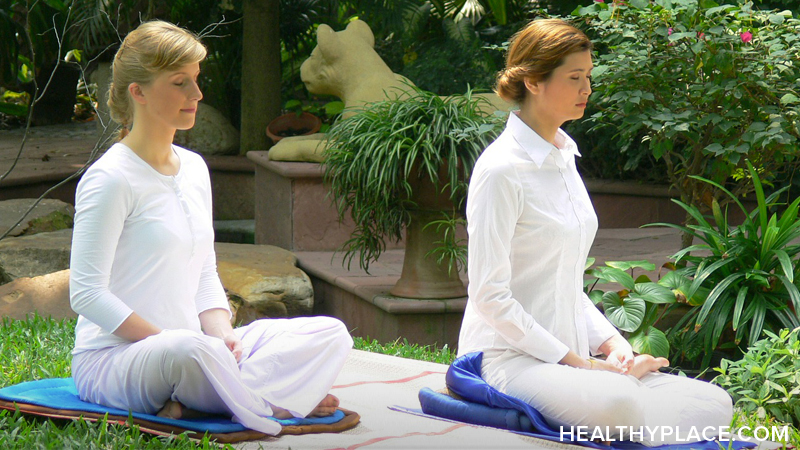
Overview of complementary and alternative therapies. What they are, who uses alternative therapies and why.
On this page:
- What Is CAM?
- CAM Therapies Included in the Survey
- How Many People Use CAM
- Who Uses CAM Most CAM
- Domains Used the Most
- CAM Therapies Used the Most
- Use of Natural Products
- Health Conditions Prompting CAM Use
- Reasons for Using CAM
- Spending on CAM
- Future Reports
Americans are using complementary and alternative medicine (CAM). But, it is often asked, how many Americans? What therapies are they using? For what health problems and concerns?
The most comprehensive and reliable findings to date on Americans' use of CAM were released in May 2004 by the National Center for Complementary and Alternative Medicine (NCCAM) and the National Center for Health Statistics (NCHS, part of the Centers for Disease Control and Prevention). They came from the 2002 edition of the NCHS's National Health Interview Survey (NHIS), an annual study in which tens of thousands of Americans are interviewed about their health- and illness-related experiences. The 2002 edition included detailed questions on CAM. It was completed by 31,044 adults aged 18 years or older from the U.S. civilian noninstitutionalized population. Some highlights from these findings begin with the section "CAM Therapies Included in the Survey". To obtain the full report, go to the end of this document.
What Is CAM?
CAM is a group of diverse medical and health care systems, practices, and products that are not presently considered to be part of conventional medicine--that is, medicine as practiced by holders of M.D. (medical doctor) or D.O. (doctor of osteopathy) degrees and their allied health professionals, such as physical therapists, psychologists, and registered nurses.a
In CAM, complementary medicine is used together with conventional medicine, and alternative medicine is used in place of conventional medicine. While some scientific evidence exists regarding some CAM therapies, for most there are key questions that are yet to be answered through well-designed scientific studies--questions such as whether these therapies are safe and whether they work for the diseases or medical conditions for which they are used. The list of what is considered to be CAM changes continually, as those therapies that are proven to be safe and effective become adopted into conventional health care and as new approaches to health care emerge.
a Other terms for conventional medicine include allopathy; Western, mainstream, orthodox, and regular medicine; and biomedicine. Some conventional medical practitioners are also practitioners of CAM.
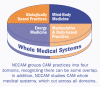
CAM Practices
Biologically based practices use substances found in nature, such as herbs, special diets, or vitamins (in doses outside those used in conventional medicine).
Energy medicine involves the use of energy fields, such as magnetic fields or biofields (energy fields that some believe surround and penetrate the human body).
Manipulative and body-based practices are based on manipulation or movement of one or more body parts.
Mind-body medicine uses a variety of techniques designed to enhance the mind's ability to affect bodily function and symptoms.
Whole medical systems are built upon complete systems of theory and practice. Often, these systems have evolved apart from and earlier than the conventional medical approach used in the United States.
CAM Therapies Included in the Survey
The survey included questions on various types of CAM therapies commonly used in the United States. These included provider-based therapies, such as acupuncture and chiropractic, and other therapies that do not require a provider, such as natural products, special diets, and megavitamin therapy. (See a complete list of therapies that were included.)
The results were analyzed including and excluding two therapies--(1) prayer specifically for health reasons and (2) megavitamins--because earlier national surveys did not consistently include these therapies.
Unless noted otherwise, the statistics are for CAM use during the 12 months prior to the 2002 survey.
CAM Therapies Included in the 2002 NHIS
An asterisk (*) indicates a practitioner-based therapy. For definitions of any of these therapies, see the full report or contact the NCCAM Clearinghouse.
- Acupuncture*
- Ayurveda*
- Biofeedback*
- Chelation therapy*
- Chiropractic care*
- Deep breathing exercises
- Diet-based therapies
- Vegetarian diet
- Macrobiotic diet
- Atkins diet
- Pritikin diet
- Energy healing therapy*
- Folk medicine*
- Guided imagery
- Homeopathic treatment
- Hypnosis*
- Massage*
- Meditation
- Megavitamin therapy
- Natural products
- (nonvitamin and nonmineral, such as herbs and other products from plants, enzymes, etc.)
- Naturopathy*
- Prayer for health reasons
- Prayed for own health
- Others ever prayed for your health
- Participate in prayer group
- Healing ritual for self
- Progressive relaxation
- Qi Gong
- Reiki *
- Tai chi
- Yoga
- Ornish diet
- Zone diet
Fig. 1: CAM Use by U.S. Adults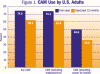 Click to enlarge |
Fig. 2: CAM Use by Race/Ethnicity Click to enlarge |
How Many People Use CAM
In the United States, 36% of adults are using some form of CAM. When megavitamin therapy and prayer specifically for health reasons are included in the definition of CAM, that number rises to 62%. (See figure 1.)
Who Uses CAM Most
CAM use spans people of all backgrounds. But, according to the survey, some people are more likely than others to use CAM. Overall, CAM use is greater by:
Women than men People with higher educational levels People who have been hospitalized in the past year Former smokers, compared with current smokers or those who have never smoked This survey was the first to yield substantial information on CAM use by minorities, and the major findings so far are shown in figure 2.
The full report provides more details about the characteristics of people who use CAM.
| Fig. 3: CAM Use by Domain and Whole Medical Systems 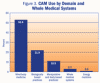 Click to enlarge |
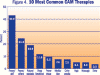
| Fig. 4: 10 Most Common |
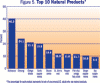
| Fig. 5: Top 10 Natural Products |
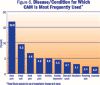
| Fig. 6: Disease/Condition for Which |
| Fig. 7: Reasons People Use CAM |

CAM Domains Used the Most
When prayer is included in the definition of CAM, the domain of mind-body medicine is the most commonly used domain (53%). (See figure 3.) When prayer is not included, biologically based therapies (22%) are more popular than mind-body medicine (17%).
CAM Therapies Used the Most
Prayer specifically for health reasons was the most commonly used CAM therapy. (See figure 4, which shows the percentage of people using each of the 10 most common therapies.) Most people who use CAM use it to treat themselves, as only about 12% of the survey respondents sought care from a licensed CAM practitioner.
Use of Natural Products
As shown in figure 4, about 19% (or one-fifth) of the people surveyed used natural products. See figure 5 for the most commonly used natural products and for the percentages of natural product users who took those products.
Health Conditions Prompting CAM Use
People use CAM for a wide array of diseases and conditions. According to the survey, Americans are most likely to use CAM for back, neck, head, or joint aches, or other painful conditions; colds; anxiety or depression; gastrointestinal disorders; or sleeping problems. (See figure 6.) It appears that CAM is most often used to treat and/or prevent musculoskeletal conditions or other conditions involving chronic or recurring pain.
Reasons for Using CAM
The survey asked people to select from five reasons to describe why they used CAM. (See figure 7.) Results were as follows (people could select more than one reason):
- CAM would improve health when used in combination with conventional medical treatments: 55%
- CAM would be interesting to try: 50%
- Conventional medical treatments would not help: 28%
- A conventional medical professional suggested trying CAM: 26%
- Conventional medical treatments are too expensive: 13%
The survey found that most people use CAM along with conventional medicine rather than in place of conventional medicine.
Spending on CAM
The NHIS did not include questions on spending on health care, but the report authors cited spending figures from national surveys conducted in 1997. Those surveys found that:1,2
- The U.S. public spent an estimated $36 billion to $47 billion on CAM therapies in 1997.
- Of this amount, between $12 billion and $20 billion was paid out-of-pocket for the services of professional CAM health care providers.
- These fees represented more than the public paid out-of-pocket for all hospitalizations in 1997 and about half of what it paid for all out-of-pocket physician services.
- $5 billion of out-of-pocket spending was on herbal products.
Future Reports
NCCAM plans to collaborate with the NCHS to analyze the survey findings further. Among the areas of interest to the researchers are how CAM use relates to various health-related behaviors, race, and gender, and whether there are differences between people who use only CAM or only conventional medicine, and those who use both. Future reports will be published.
1Eisenberg DM, Davis RB, Ettner SL, et al. Trends in alternative medicine use in the United States, 1990-1997: results of a follow-up national survey. JAMA. 1998;280(18):1569-1575.
2Centers for Medicare & Medicaid Services. 1997 National Health Expenditures Survey. Centers for Medicare & Medicaid Services Web site. Available at http://www.cms.hhs.gov/.
About NCCAM
NCCAM, a component of the National Institutes of Health, is dedicated to exploring complementary and alternative healing practices in the context of rigorous science, training CAM researchers, and disseminating authoritative information to the public and professionals.
To Obtain the Report
The report's citation is Barnes P, Powell-Griner E, McFann K, Nahin R. CDC Advance Data Report #343. Complementary and alternative medicine use among adults: United States, 2002. May 27, 2004. It is available, along with a press release and graphics, at http://nccam.nih.gov/news/camstats.htm.
For More Information
To learn more about CAM, including individual CAM therapies, visit the NCCAM Web site at www.nccam.nih.gov, or call the NCCAM Clearinghouse toll-free in the U.S. at 1-888-644-6226. Services include fact sheets, other publications, and searches of Federal databases of scientific and medical literature. The Clearinghouse does not provide medical advice or referrals to practitioners.
APA Reference
Staff, H.
(2008, November 10). Statistics on CAM Use, HealthyPlace. Retrieved
on 2024, April 19 from https://www.healthyplace.com/alternative-mental-health/treatments/statistics-on-cam-use